I think these three quotes all say the same thing. Do you?
Now here's the pivotal point: the neurology and functioning of the brain create a mercurial type of human consciousness that is universal. And the ways in which that consciousness can be accommodated in daily life by human beings are not infinite, as world ethnography, spanning a multitude of cultures, indeed shows.
David Lewis-Williams and David Pearce (2005), Inside the Neolithic Mind, p.9
[Our perception of aliens] is to do with the ambivalent nature of consciousness and our uneasy sense of being both within the world and outside it. This is, in part, a commentary on modernity, but also it is about an eternal aspect of the human predicament that has been massively amplified but not created by modernity.... For now, I need simply say that I start from the undoubted reality of aliens. they may or may not exist but they are all around us and they are trying to tell us something, possibly about themselves, but certainly about us. In order to understand what they are saying it is necessary to abandon the usual barriers between fiction and reality. There are many important connections between the aliens in Star Trek, H. G. Wells' Martians, the abductors of Betty and Barney Hill, the cattle mutilators in Montana and the committee of beings known as the Nine who speak through the Florida medium Phyllis V. Schlemmer. These connections form an enormous mirror of ourselves and of our age, through which, like Alice, we can pass and find ourselves in a different world.
Bryan Appleyard (2005), Aliens: Why They Are Here, p.9
What is The Filth?
The Filth contains the active ingredient metaphor.
Metaphor is one of a group of problem-solving medicines known as figures of speech which are normally used to treat literal thinking and other diseases. Metaphor combines two or more seemingly unrelated concepts in a way that stimulates lateral thought processes and creativity...
What is The Filth used for?
This comic book is used to treat all manner of disorders including Internet pornography addiction, insomnia, grief, "mid-life" crisis, schizophrenia, the ignorance of samsara and the 21st century blues, especially in patients whose millennial anxiety and general paranoia has not yet responded to normal treatments.
When must The Filth not be used?
If your doctor has advised you to avoid the use of metaphor.
If you refuse to acknowledge the mocking laughter of the Abyss.
If you cannot face the fact that your entire immediate environment is a seething battlefield of microscopic predators, prey and excreta and, simultaneously, a rich and complex metaphor.
Grant Morrison (2004), The Filth, opening pages.
I think each of these is saying that culture is by definition fiction, because we make it up. And nature is by definition reality. And to be human, we have to hold the two in tandem. We can't avoid it. It's what we do.
I think what we do, what all of us do with this tension, is make church.
Wednesday, 31 March 2010

Friday, 26 March 2010
714 - Greenbelt Festival, Cheltenham, 2009, 3/3

Lots of reinvention goes on. This is a focus for meditation produced by an emerging church from, I think, London. Frozen inside a block of ice were hundreds of kitsch Christian images, plastic bangles, crosses, 'Jesus and Mary's. The block was always surrounded by a crowd of teens, till it had gone. Brilliant.
716 - Greenbelt Festival, Cheltenham, 2009 1/3

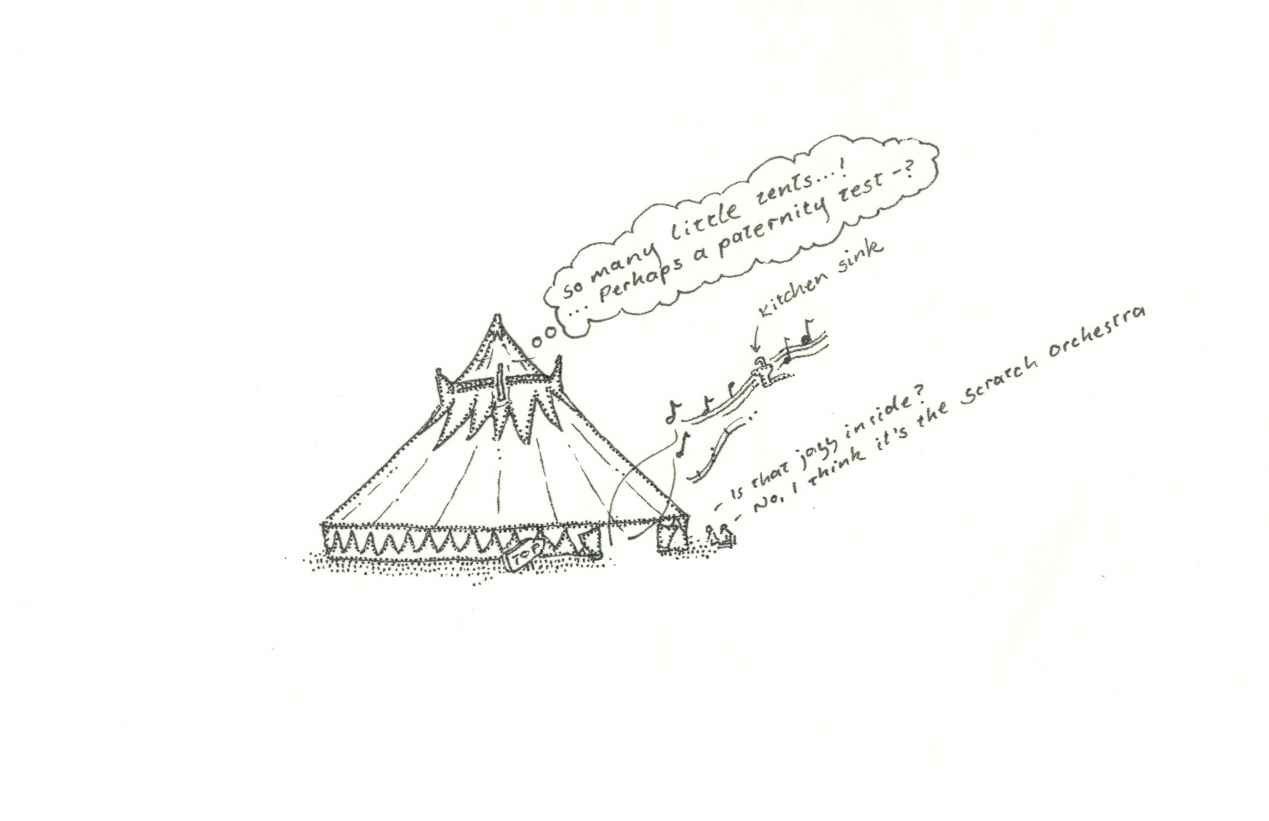
Greenbelt is described by Mona Siddiqi as Radio 4 in tents. It's an arts festival, run primarily by (and it has to be said, for) Christians, but with a commendably open and searching approach. I feel at home there. I had plans to draw a massive doodle, but ran out of time. Here's the first of three thumbnail sketches, inside a tent, with a panel discussion, possibly about psychogeography, going on. There were more than three other people present!
Thursday, 25 March 2010
717 - Memory, Nostalgia and Civil Rights

Imagine if the memories of Whitley Bay submitted by you and I to Francis Frith were manipulable, erasable, through targeted pill use or disruptive stimulation. We could forget the Dome ever was, our trip to the seaside having been prevented from forming. That kiss-me-quick under the wurlitzers? The dodgy B&B we stayed in? Gone. Or last week's return trip - how downbeat, compared to the childhood memory, how disappointing. You could lift it, replace it with happier times (though the physical buildings, and our bodies, would still degrade).
Well, they are, just about. A report on Radio 4 this morning described one recent experiment where memories of traumatic images from old public information films were prevented from 'developing' - it takes six hours for them to set in place, it seems - by having viewers play Tetris after watching (the cognitive processes used are so similar, the brain 'forgets' to remember the film images). The Today programme interviewed Anders Sandberg and AC Grayling afterwards. Both agreed that such technologies are useful for dealing with disfunctional memories - induced, for example, by post traumatic stress - but they raise profound questions about what it means to be human.
We are our memories, bad as well as good. Or is that actually true? Perhaps we can 'dress up' in fresh memories, the way you'd wear a smarter dress if you had the choice. Why, in a meritocracy, let a shoddy past hold you back?
This is why, in a blog dedicated to Whitley Bay, I've spent so much time getting my thoughts straight about communal and personal identity. It really does impact on the real world. Whitley, a nostalgia-buff's wet dream, has a stronger identity than most, and one, perhaps, more often let down. The seaside town's journey to find a new identity offers a perfect case study for reflection on the kinds of questions raised by neuroscientific and biotechnological research into identity formation. (Perhaps a bid could be prepared for some of the new seaside town regeneration money, also announced today on the programme, to fund a research project into nostalgia and its cure.)
I call the creative use of fresh and manipulated identities storying, because I believe stories, in all their beauty, are both the outcome, and the best tools by which we may get a handle on our identies. The potential is huge, but scary, and I suspect attempts will be made to control such technologies, not always for the best of reasons.
I reckon I'm pretty much on the money, too. The joke in the interview was that our grandchildren will look back at us as Neanderthals, exclaiming, as James Naughtie put it, 'They didn't know what pill to take!'. More pertinently, Sandberg explained, our right to control what goes on cognitively in our own heads should be "considered one of our basic liberal freedoms".
Storying is a civil rights movement.
Wednesday, 24 March 2010
718 - Whitley Bay Memories

"But kindly lower your gaze to the lone car. It is a Vauxhall 14 and it is parked outside 7 The Links, my old home. Despite being 16 years old it was the coveted company car of my dad, Eric, works manager for a firm that made concrete lamp standards at the old Cramlington Airship Shed." (Colin Henderson)
From a short collection of Whitley Bay memories submitted by users of the Francis Frith website - worth a read!
Monday, 22 March 2010
719 - Personality and Consciousness
Geoffrey Miller, in Spent, documents research into five key personality traits, and concludes that, together with General Intelligence (or IQ), they give us pretty much all we need to know about the inner life of the people we meet. The traits are openness, conscientiousness, agreeability, stability and extroversion. Broadly speaking, populations are distributed in a bell-curve across every trait, and also across IQ. There are few correlations between trait scores, although openness correlates fairly positively with IQ.
Miller suggests IQ is a measure of the healthy functioning of our nervous system, and the personality traits reflect survival and reproduction strategies adopted by our earliest ancestors. Daniel Nettle, in Personality, suggests that openness is a measure of the breadth of connections we make amongst concepts and sensory stimuli. Although there is no moral value attached either to high or low scores in any trait, different communities have favoured traits differently at different times.
Openness carries with it the benefits of creativity, but the risks of psychosis. Nettle argues that openness evolved as the ability to manipulate symbols became increasingly valuable in early human communities. Miller wonders whether displays of extreme openness amongst the young reflect a strategy for demonstrating the essential soundness of their minds.
Openness is linked to artistic creativity, as well as receptivity to unusual experiences, and as such, one might hypothesize, is important to any consideration of spirituality and religion, though a high score would not predict religiosity, which has frequently a conservative bias.
But David Lewis-Williams and David Pearce, in Inside The Neolithic Mind, offer an alternative measure by which the religious content of a community might be explained. They locate the source of religious imagery in experiences of altered states of consciousness. Our minds function across a spectrum of consciousness, from attentiveness to waking reality, through periods of reflectivity, to daydreaming, hypnagogic states, and finally, in sleep, our normal dreamlife. The modern west, they suggest, values the wide awake, rational state, where earlier cultures favoured the various dream states. Therefore, earlier cultures developed concepts of dream wisdom and spiritual realms, which we abandon (perhaps legitimately) for logic and empiricism.
It is certainly very pleasing to correlate religious concepts of the immanence and transcendance of spiritual powers with, respectively, attentiveness to the details of reality, and dreaming swoons. It is also intriguing to ask whether measures of openness and of consciousness correlate. If they do, one might ask whether they are interdependent, or in fact facets of a single trait. If they don't, it might be fair to ask that consciousness be accorded value as a mental trait in its own right.
Perhaps the consciousness spectrum will be found to equate to IQ, instead, except that high alertness might exist in dream states as well as maths tests, but some might prefer to operate in the former, whilst others are predisposed to the latter. If you choose one rather than the other strategy for obtaining survival tips, this may fairly be described as an aspect of your personality, rather than a measure, like IQ, of general health. In any case, whatever the analysis, one might expect preferences to be distributed in a bell-curve across the human population, in much the same way as other traits.
Miller suggests IQ is a measure of the healthy functioning of our nervous system, and the personality traits reflect survival and reproduction strategies adopted by our earliest ancestors. Daniel Nettle, in Personality, suggests that openness is a measure of the breadth of connections we make amongst concepts and sensory stimuli. Although there is no moral value attached either to high or low scores in any trait, different communities have favoured traits differently at different times.
Openness carries with it the benefits of creativity, but the risks of psychosis. Nettle argues that openness evolved as the ability to manipulate symbols became increasingly valuable in early human communities. Miller wonders whether displays of extreme openness amongst the young reflect a strategy for demonstrating the essential soundness of their minds.
Openness is linked to artistic creativity, as well as receptivity to unusual experiences, and as such, one might hypothesize, is important to any consideration of spirituality and religion, though a high score would not predict religiosity, which has frequently a conservative bias.
But David Lewis-Williams and David Pearce, in Inside The Neolithic Mind, offer an alternative measure by which the religious content of a community might be explained. They locate the source of religious imagery in experiences of altered states of consciousness. Our minds function across a spectrum of consciousness, from attentiveness to waking reality, through periods of reflectivity, to daydreaming, hypnagogic states, and finally, in sleep, our normal dreamlife. The modern west, they suggest, values the wide awake, rational state, where earlier cultures favoured the various dream states. Therefore, earlier cultures developed concepts of dream wisdom and spiritual realms, which we abandon (perhaps legitimately) for logic and empiricism.
It is certainly very pleasing to correlate religious concepts of the immanence and transcendance of spiritual powers with, respectively, attentiveness to the details of reality, and dreaming swoons. It is also intriguing to ask whether measures of openness and of consciousness correlate. If they do, one might ask whether they are interdependent, or in fact facets of a single trait. If they don't, it might be fair to ask that consciousness be accorded value as a mental trait in its own right.
Perhaps the consciousness spectrum will be found to equate to IQ, instead, except that high alertness might exist in dream states as well as maths tests, but some might prefer to operate in the former, whilst others are predisposed to the latter. If you choose one rather than the other strategy for obtaining survival tips, this may fairly be described as an aspect of your personality, rather than a measure, like IQ, of general health. In any case, whatever the analysis, one might expect preferences to be distributed in a bell-curve across the human population, in much the same way as other traits.
Subscribe to:
Posts (Atom)


 Posts
Posts

